Articles Posted in Environmental

Posted

In the case of Defenders of Wildlife. et al., v. Zinke., et al., the U.S. Court of Appeals for the DC Circuit reversed the U.S. Gray-Wolf-300x210District Court for the District of Columbia, and reinstated the U.S. Department of the Interior’s  2012 decision to delist the Wyoming Gray Wolf, which had been listed as an endangered species under the Endangered Species Act (ESA) in 1973. The District Court vacated the rule, holding that the Fish and Wildlife Service’s determination that that the State of Wyoming had put in place adequate regulatory mechanisms in the conservation management plan of the State of Wyoming (Wyoming Management Plan) to protect the wolf was arbitrary.

Continue Reading ›

Posted

In Government of the Province of Manitoba v. Zinke, the U.S. Court of Appeals for the DC Circuit reversed the U.S. District Court for the District of Columbia and held that the State of North Dakota could begin designing a water treatment plant for an area of North Dakota whose public drinking water quality has been substandard for a long time. The project is known as the Northwest Area Water Supply Project. The District Court had rejected the State’s request to modify an injunction that kept the project from moving forward. Reviewing the District Court’s ruling, the DC Circuit has held that the District Court abused its discretion in not accepting North Dakota’s argument that a significant change in circumstances warranted this relief.

Continue Reading ›

Posted

In Energy Storage: Finding New Home with FERC Policy Statement and Notice of Proposed Rulemaking, my colleagues Michael Hindus, Kevin Ashe and I discuss the Federal Regulatory Agency Commission’s (FERC) November 2016 notice of proposed rulemaking (NOPR), January 19 policy statement confirming that electric storage resources may be able to recover both cost-based and market-based rates, and market participates’ comments on the FERC’s NOPR. Market participants seeking to bring storage resources to the wholesale electricity marketplace are encouraged to consider the implications of these recent efforts to incorporate electric storage on a wider scale.

Posted

Earlier today, we published our client alert Trump Administration Seeks to Limit Coverage of Clean Water Act, Executive order to set out a new definition of “Waters of the United States” discussing a February 28, 2017 executive order directing that the Waters of the United States Rule (commonly referred to as the WOTUS Rule) be reviewed and revised or repealed. Although the executive order starts the process, its completion is expected to take at least a year or two given the formal administrative process required for repeal or replacement. In 2016, the WOTUS rule was stayed by the Sixth Circuit Court of Appeals pending further action. The repeal will be significant for project developers, such as solar projects and real estate developers, as well as for farmers and ranchers, mining companies and other energy companies. More administrative actions are expected given the aggressive approach by the Trump Administration to roll back the Obama Administration’s regulation on this issue.

Additional Source:  Presidential Executive Order on Restoring the Rule of Law, Federalism, and Economic Growth by Reviewing the “Waters of the United States” Rule; Construction Industry to See Greater Federal Footprint in Projects with New “Waters of the United States” Rule

Posted

On February 24, the Texas Supreme Court released several decisions, including two rulings involving aspects of environmental law. The cases are ExxonMobil Corporation v. Lazy R Ranch, et al., and ExxonMobil Pipeline Company, et al., v. Coleman.

Continue Reading ›

Posted

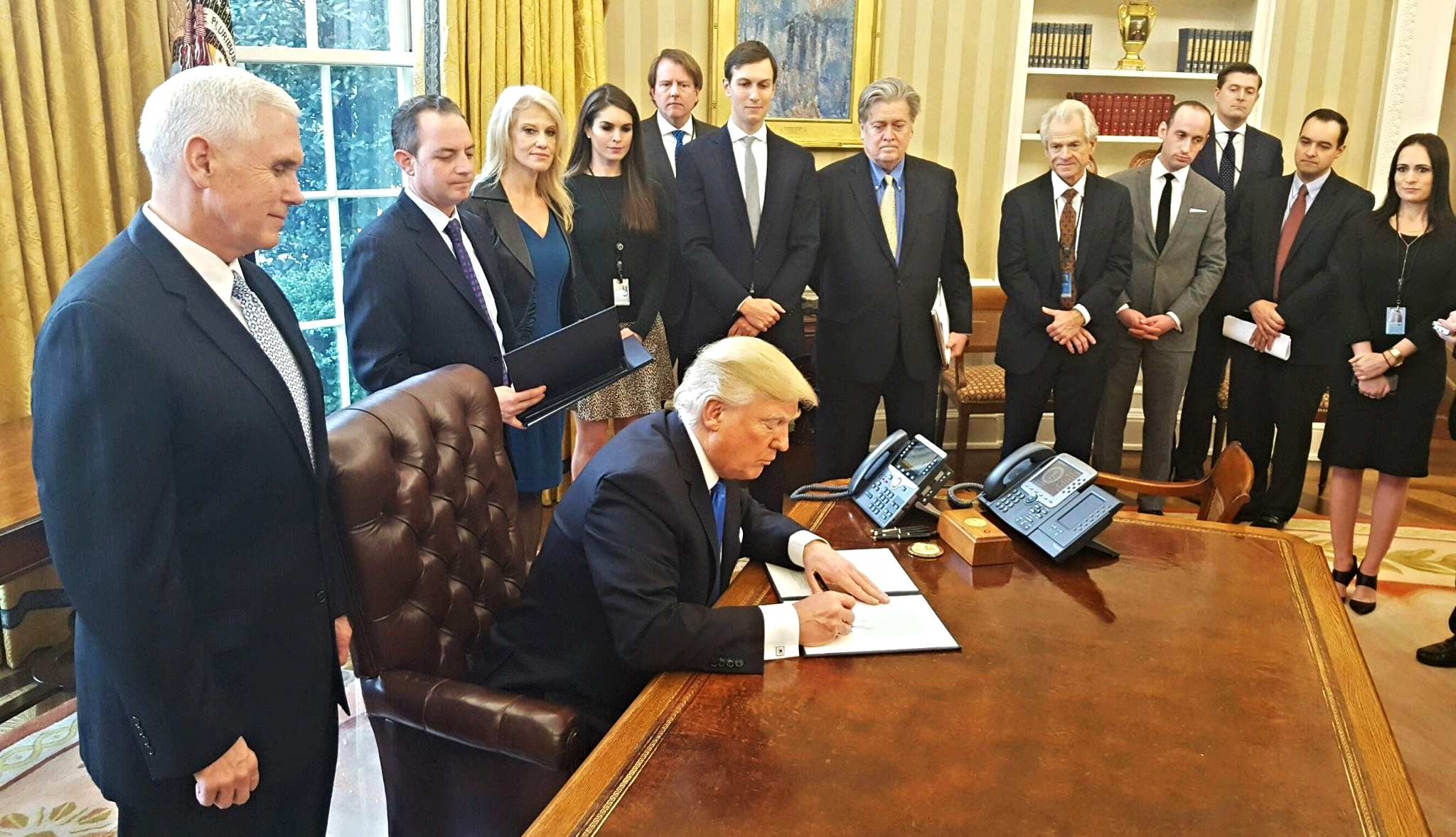
Referencing Executive Orders issued by past administrations, on February 24, 2017, President Trump issued a new Whitehouse-300x225Executive Order: “Enforcing the Regulatory Reform Agenda.” The Executive Order establishes new procedures and timelines by which most federal administrative agencies must conduct their regulatory planning and review.

Continue Reading ›

Posted

In The Texas Supreme Court Clarifies “Common Carrier” Status Criteria, Pillsbury attorneys Anthony Raven, Olivia Matsushita and Andrew White discuss the Texas Supreme Court’s recent opinion in Denbury Green Pipeline-Texas, LLC v. Texas Rice Land Partners, Ltd. Among other things, the Court provides judicial clarity on the “reasonable probability” public use test that might positively demonstrate that a pipeline owner is a common carrier for the purposes of Texas law. Affected private landowners will still be able to challenge a CO pipeline owner’s self-designation as a common carrier.

Additional Source: Securing Rights-of-Way to CO2 Pipeline Corridors in the United States; The Future of Carbon Dioxide Injection EOR in the United States

Posted

On February 14, the Supreme Judicial Court of Massachusetts reviewed the application of the state’s “anti-SLAPP” law to challenges made against a blogged critique of Cardno Chemrisk, LLC (Chemrisk) and British Oetroleum (BP) in the case of Cardno Chemrisk, LLC v. Cherri Foytlin & Another, confirming that it protects pamphleteers/bloggers. Continue Reading ›

Posted

On February 9, the Oregon Supreme Court affirmed the decisions of the Oregon Environmental Quality Commission (OEQC) and the Oregon Court of Appeals that Oil Re-Refining Company (ORRCO) was strictly liable for “simple” violations of the Oregon State Resource Conservation and Recovery Act (RCRA) rules. The case is Oregon Re-Refining Company v. Environmental Quality Commission of the Department of Environmental Quality for the State of Oregon.

Continue Reading ›

Posted

On February 13, a sharply divided U.S. Court of Appeals for the Fifth Circuit , by a vote of 8 to 6, rejected a petition seeking

Frog-300x225

The Dusky Gopher Frog, once known as the Mississippi Gopher Frog, has an average length of about three inches and a stocky body with colors on its back that range from black to brown or gray and is covered with dark spots and warts. (Western Carolina University photo/ John A. Tupy)

an en banc rehearing of the court’s initial decision in the case of Markel Interests, LLC, et al., v. U.S. Fish and Wildlife Service, et al. In its June 5, 2016 decision, the Fifth Circuit held that 1500 acres of private land located in Louisiana is subject to the requirements of the Endangered Species Act (ESA) with respect to the dusky gopher frog, which was determined to be an endangered species in 2001, but whose “critical habitat” was not designated until 2012. At the present time, the species is located only in Mississippi, but the U.S. Fish and Wildlife Service (Service) designated not only several thousand acres of Mississippi land as its critical habitat, but land in Louisiana as well, reasoning that the presence of five ephemeral ponds on the Louisiana land could support the species’ reproduction. Apart from the presence of these ponds, all parties appear to agree that the Louisiana land is otherwise uninhabitable.

Continue Reading ›